
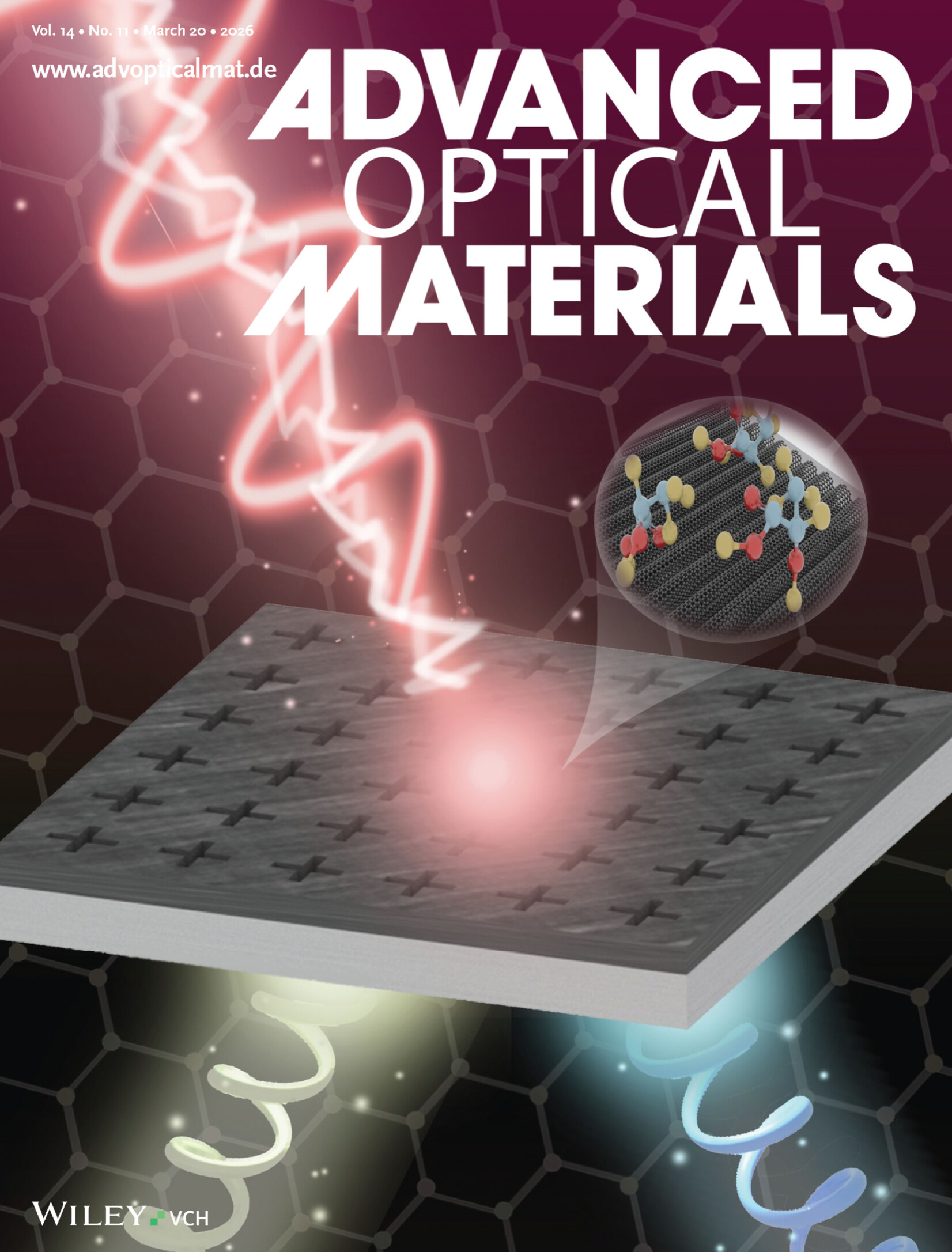
Recently, a graduate student from the Shaanxi Key Laboratory of Ultrafast Optoelectronics and Terahertz Science, School of Optoelectronic Science and Intelligent Instrumentation, published a research paper entitled Aligned Single-Walled Carbon Nanotubes Film Chiral Metasurfaces for Terahertz Polarization Sensing in the prestigious optical journal Advanced Optical Materials, with our university listed as the first affiliated unit. The paper was also selected as the cover paper of the current issue.
Chen Xiangdong, a 2023 postgraduate student majoring in Physics at the School of Optoelectronic Science and Intelligent Instrumentation, is the first author of the paper, and Professor Wang Yue is the sole corresponding author. Dr. Zhang Xiang from Xi'an University of Technology, Professor Chang Shengjiang, Professor Fan Fei and Dr. Shen Peng from Nankai University made important contributions to this work.
In recent years, biosensors based on metasurfaces have attracted extensive attention due to their fast response, label-free detection and high sensitivity. However, existing chiral metasurface sensors involve asymmetric structures, which lead to high manufacturing costs, complex processes and long production cycles. In addition, these sensors have limited capability in detecting chiral molecules in the terahertz band, making it difficult to accurately distinguish chiral enantiomers.
This paper proposes a terahertz chiral metasurface based on aligned single-walled carbon nanotube films, which achieves chiral effects without the need for complex symmetry-breaking structures. The metasurface device is applied to the polarization sensing and detection of lactic acid enantiomers, realizing qualitative differentiation and quantitative concentration detection of lactic acid enantiomers in the terahertz band. It also reconstructs the polarization state after the interaction between light and matter, obtaining more information about the target analytes. Compared with traditional transmission/reflection sensing methods, this approach enables more intuitive and comprehensive observation of the chiral characteristics of analytes. This work provides new insights for the design and application of chiral optoelectronic devices.
Publication link: https://doi.org/10.1002/adom.202501993
Written by: Zhang Xiang
Reviewed by: Di Huige