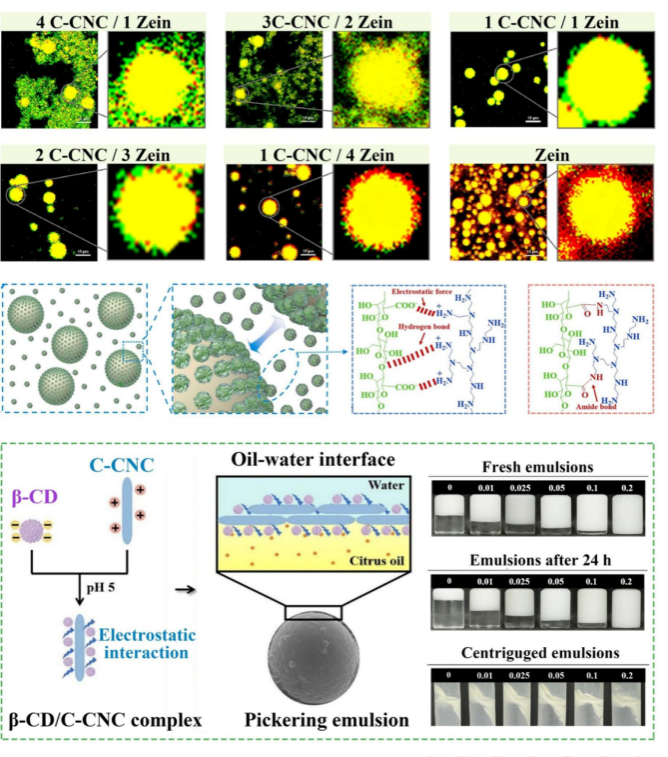
Recently, Li Fan, a young faculty member from the School of Printing, Packaging and Digital Media at Xi’an University of Technology, published a significant review article in Trends in Food Science & Technology (Impact Factor: 15.4, CAS Q1, TOP journal), one of the leading international journals in the field of food science. The paper, entitled “Active Packaging Based on Nanocellulose-Stabilized Essential Oil Pickering Emulsions: A Review on Enhanced Properties and Food Preservation Applications,” systematically summarizes the latest advances in essential oil/nanocellulose Pickering emulsion-based food packaging, marking an important contribution by the School in the field of active packaging research.
Xi’an University of Technology’s School of Printing, Packaging and Digital Media is listed as the first affiliation. Li Fan, a member of the Green Printing and Packaging Technology and Biological Resources Research Team, is the first author, and Professor Zhou Xing, the team leader, serves as the corresponding author. The research team focuses primarily on polymer-based functional composite materials, high-value conversion of waste polymers, and intelligent equipment manufacturing technologies. As the first author, Li Fan has published multiple academic papers in prestigious journals, including Trends in Food Science & Technology, Food Hydrocolloids, Chemical Engineering Journal, Food Chemistry, ACS Sustainable Chemistry & Engineering, and ACS Applied Materials & Interfaces.
The review highlights that nanocellulose, owing to its distinctive physicochemical properties and excellent biocompatibility, has emerged as an ideal stabilizing material for essential oil Pickering emulsions. Essential oil/nanocellulose Pickering emulsions provide a novel approach to enhancing the functionality of food packaging materials. The paper systematically reviews preparation methods and modification strategies for such emulsions, analyzes their performance enhancement effects on packaging films, and summarizes their applications in active packaging for perishable foods. The findings demonstrate that essential oil/nanocellulose Pickering emulsions can significantly improve the mechanical strength, barrier performance, antimicrobial activity, and antioxidant properties of packaging films, thereby effectively extending the shelf life of meat and fruit products.
The study further indicates that future research should focus on reducing the production cost of nanocellulose, improving particle size uniformity, balancing essential oil loading efficiency with long-term stability, and establishing comprehensive toxicological evaluation systems. This review provides valuable theoretical and technical references for advancing the development and practical application of Pickering emulsions in food packaging.
Original Article: https://doi.org/10.1016/j.tifs.2025.105465
Written by: Li Fan
Reviewed by: Zhou Xing