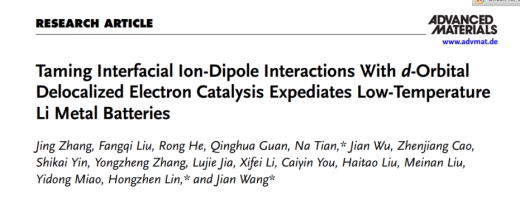
Recently, the Functional Metallic Materials Research Team of the School of Materials Science and Engineering at Xi’an University of Technology achieved significant academic progress in the field of energy electrode materials. The related research findings were published in the internationally renowned materials science journal Advanced Materials (Impact Factor: 26.8) under the title “Taming Interfacial Ion–Dipole Interactions With d-Orbital Delocalized Electron Catalysis Expediates Low-Temperature Li Metal Batteries.”
The study was conducted through collaborative efforts among Xi’an University of Technology, the Suzhou Institute of Nano-Tech and Nano-Bionics of the Chinese Academy of Sciences, and the Helmholtz Institute for Electrochemical Energy Storage in Germany. Xi’an University of Technology is the first affiliation. Associate Professor Zhang Jing from the School of Materials Science and Engineering is the first author. Professor Tian Na of Xi’an University of Technology, Researcher Lin Hongzhen of the Suzhou Institute of Nano-Tech and Nano-Bionics, and Researcher Wang Jian of the Helmholtz Institute for Electrochemical Energy Storage serve as co-corresponding authors.
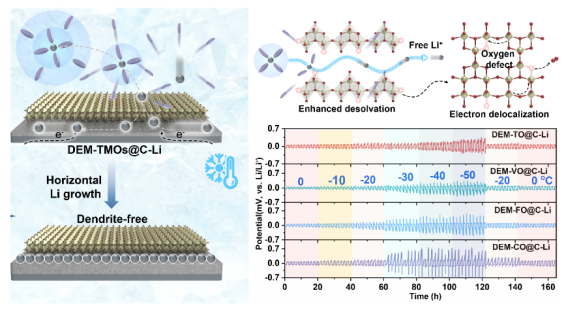
The research employs electron delocalization engineering to regulate catalytic activity. By catalytically reconstructing the solvation sheath of the [Li(solvent)x⁺] complex under low-temperature conditions, the system facilitates the rapid release of free Li⁺ ions, accelerates ion diffusion kinetics, and effectively suppresses dendrite formation. A series of metal oxides with d-orbital electron delocalization (M = Ti, V, Fe, Co) were systematically screened. The team conducted comprehensive theoretical simulations and experimental evaluations at electrode/electrolyte interfaces, revealing the catalytic mechanism by which optimized electronic structures modulate ion–dipole interactions, regulate solvation structures, and enhance ion transport to achieve long-cycle-life lithium metal batteries under low-temperature conditions.
Figure: Delocalized electron catalysts reconstruct the solvation sheath to enable high-performance low-temperature lithium metal batteries.
In response to major national strategic priorities, including China’s “Dual Carbon” goals and next-generation 5G communication technologies, Professor You Caiyin, head of the research team, has led the Functional Metallic Materials Group in focusing on key materials and core technologies in power electronics, information storage, and energy storage systems. The team has achieved a series of research breakthroughs in magnetoelectric functional materials, flexible electronic devices, microwave absorption and electromagnetic shielding materials, and energy storage technologies.
More recently, Associate Professor Liu Heguang, as first author, and Professor You Caiyin, as corresponding author, reported important advances in electromagnetic shielding and microwave-absorbing functional materials. These findings were successively published in leading international journals in the materials field, including ACS Nano (SCI, Impact Factor: 16.1) and Advanced Powder Materials (Impact Factor: 24.9).
Article Links:
https://doi.org/10.1002/adma.202510894
https://doi.org/10.1016/j.apmate.2025.100300
https://doi.org/10.1021/acsnano.4c13329
Written by: Zhang Jing
Reviewed by: Li Xifei