Professor He Yangqing of the School of Eco-Environmental & Chemical Engineering and Associate Professor Yang Man of the School of Materials Science and Engineering at Xi’an University of Technology (XAUT), working with Associate Professor Zhang Rui of Shanghai Institute of Technology and Associate Professor Ren Yujing of Northwestern Polytechnical University, have made important progress in regulating the coordination environments of active sites in heterogeneous catalysts.
Their findings have been published in the Journal of the American Chemical Society (JACS), a leading international chemistry journal, under the title “Nonsteady-State Oxidative Modulation of Pt Coordination on CeO₂ to Balance the Activity–Selectivity Trade-Off in the Selective Hydrogenation of Nitroarenes.” Lu Jing, a 2026 master’s graduate of XAUT, is the first author. He Yangqing, Yang Man, Zhang Rui, and Ren Yujing are the corresponding authors.
Article link: https://doi.org/10.1021/jacs.6c17463
Achieving both high catalytic activity and high product selectivity remains a major challenge in heterogeneous catalyst design. For organic molecules containing multiple reducible functional groups, conventional metal catalysts often struggle to selectively convert the target group. Competing hydrogenation reactions can occur, making it difficult to improve activity and selectivity simultaneously. Overcoming this trade-off through structural regulation of catalytic active sites is therefore central to developing efficient catalysts for selective hydrogenation.
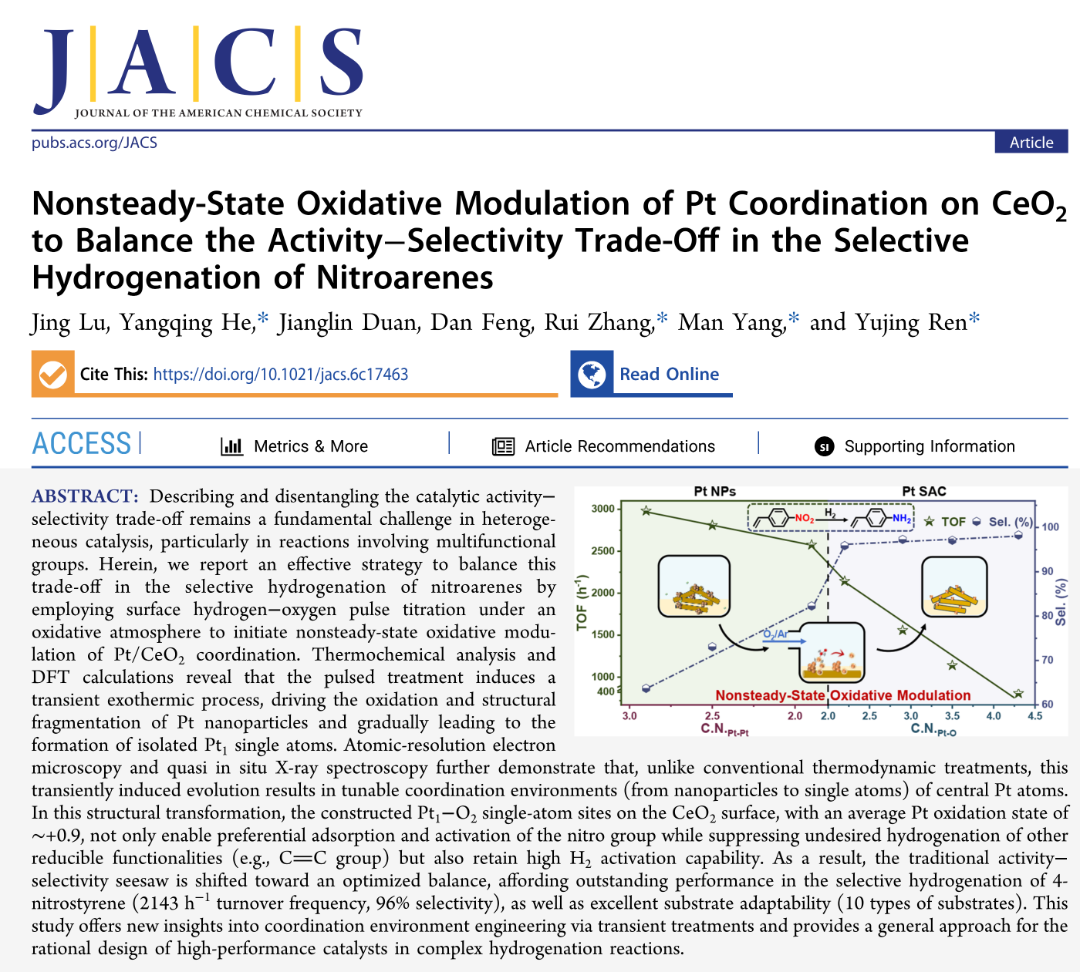
To address this challenge, the researchers developed a nonsteady-state oxidative modulation strategy. By introducing a transient exothermic oxidation process, they achieved controlled changes in the coordination structures of Pt species in Pt/CeO₂ catalysts, producing a Pt₁/CeO₂ single-atom catalyst with both high activity and high selectivity. The approach overcomes limitations associated with conventional thermodynamic treatments and offers a new route to the precise construction of active sites in heterogeneous catalysts.
The study found that transient heat release induced by surface hydrogen–oxygen pulse titration promotes the oxidation of Pt nanoparticles and drives their gradual transformation into isolated single-atom sites. Using atomic-resolution electron microscopy, quasi-in situ X-ray absorption spectroscopy, thermochemical analysis, and density functional theory calculations, the researchers systematically investigated the structural evolution of Pt species during nonsteady-state oxidative modulation and the mechanisms underlying their catalytic performance.
The resulting Pt₁–O₂ single-atom sites feature a distinctive low-coordination structure. These sites retain a strong capacity for hydrogen activation while promoting the preferential adsorption and activation of nitro groups. At the same time, they effectively suppress competing hydrogenation of other reducible functional groups, including carbon–carbon double bonds, enabling the coordinated optimization of activity and selectivity.
As a result, the Pt₁/CeO₂ single-atom catalyst exhibited excellent performance in the selective hydrogenation of 4-nitrostyrene, achieving a turnover frequency of 2,143 h⁻¹ and approximately 96% selectivity. The catalytic system also demonstrated broad substrate scope and good recycling stability.
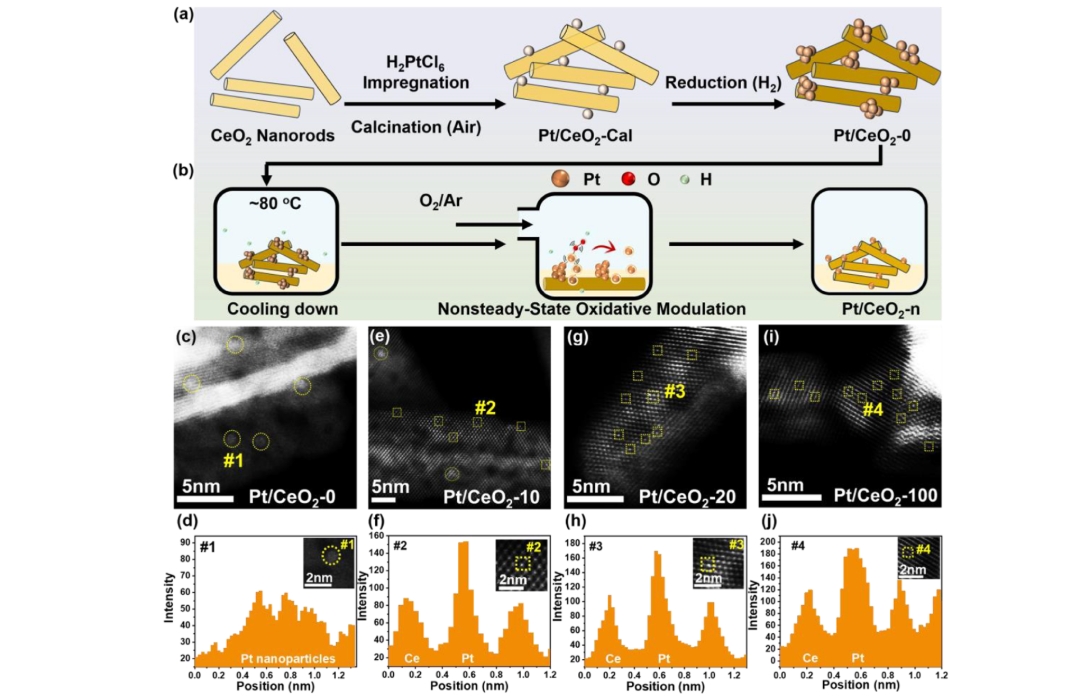
(a) Synthesis of the conventional Pt/CeO₂ catalyst;
(b) schematic illustration of the Pt/CeO₂-n catalysts obtained through subsequent nonsteady-state oxidative modulation;
and (c–j) electron microscopy characterization of the Pt/CeO₂-n catalysts.
The research reveals how metal active sites evolve during nonsteady-state oxidation and establishes a relationship between the local coordination environment of Pt and its catalytic activity and selectivity. These findings provide new insights into the longstanding activity–selectivity trade-off in heterogeneous catalysis. By extending catalyst structure regulation beyond conventional steady-state conditions, the study also offers a strategy for using transient processes to precisely construct high-performance metal catalytic sites.
The research was supported by the National Key Research and Development Program of China (2023YFA1506603), the National Natural Science Foundation of China (22472131, 22478316, 52570214, and 22303031), the Shaanxi Provincial Key Research and Development Program (2025GH-YBXM-001), and other funding sources.
He Yangqing is a professor and doctoral supervisor. He has led or participated in more than ten research projects, including General Program projects funded by the National Natural Science Foundation of China, projects under Shaanxi’s Key Industrial Innovation Chain (Cluster) initiative, the Shaanxi Provincial Key Research and Development Program, Shaanxi science and technology research programs, and the Gansu Provincial Key Research and Development Program. He has also participated in one National Science and Technology Major Project.
His research focuses on the precise regulation of organic semiconductor photocatalytic materials and the screening of natural lead compounds with antidiabetic activity. In recent years, he has published more than 50 SCI-indexed papers in journals including the Journal of the American Chemical Society, Chemical Engineering Journal, Journal of Natural Products, and ACS Catalysis. These include 11 papers in journals classified in Division 1 of the Chinese Academy of Sciences journal ranking system and four papers in journals with impact factors above 15.
He has contributed to two textbooks, Phytochemistry and Structural Elucidation of Natural Products, and has filed more than ten Chinese invention patent applications, nine of which have been granted. His honors include a First Prize in the Shaanxi Higher Education Science and Technology Awards, a Third Prize in the Fourth Shaanxi Provincial Teaching Innovation Competition, and a First Prize in XAUT’s Teaching Innovation Competition. He has also received university recognition as an Outstanding CPC Member, an Outstanding Individual in Research, an Advanced Individual in Research, and an Outstanding Young Teacher. He was included in the World’s Top 2% Scientists list released by Stanford University and Elsevier for six consecutive years from 2021 to 2026.
Yang Man is an associate professor and master’s supervisor. She earned her doctorate at the Dalian Institute of Chemical Physics, Chinese Academy of Sciences, through the University of Chinese Academy of Sciences. She is a core member of a Shaanxi university young innovation team.
She has been selected for the Young Top Talent category of the Shaanxi Provincial High-Level Talent Program, the Young Talent Support Program of the Shaanxi Association for Science and Technology, and Xi’an’s Young Scientific and Technological Talent Program. She has also received support through XAUT’s Young Science and Technology Rising Star initiative, Outstanding Young Talent Support Program, and Zhufeng Zhuyuan Talent Program.
Her research focuses on the application of single-atom catalytic materials in new energy, environmental technologies, and green chemical synthesis. She has led more than ten government-funded research projects at national, provincial, ministerial, and other levels. As first or corresponding author, she has published more than 20 SCI-indexed papers in leading international journals, including the Journal of the American Chemical Society, Joule, ACS Catalysis, and Applied Catalysis B: Environmental. She holds ten granted Chinese invention patents.
She serves on the early-career editorial boards of journals including Rare Metals and has been recognized as a Shaanxi Young Scholar in Qinling Ecological and Environmental Protection.